
You have been sucessfully logged out.

The treatment of lymphoma can vary considerably depending on the type of lymphoma and the individual patient. The treatment of non-Hodgkin lymphoma depends, among other factors, on the patient's age, whether the lymphoma is aggressive, and the stage of the disease.
The main types of treatment for lymphoma comprise:
Chemotherapy
Chemotherapy is used to kill cancer cells. It prevents cell division and therefore the growth of cancer cells.
Immunotherapy
Immunotherapy uses the patient’s immune system to address cancer. An example of immunotherapy is monoclonal antibodies.
Radiotherapy
Radiotherapy uses radiation to destroy cancer cells.
Cell therapy
Cell therapy is a treatment in which living cells are used to address the disease. Examples include CAR T-cell therapy and stem cell transplants.
Targeted therapies
Medicines that are aimed at specific abnormalities of cancer cells.
For more information about a specific treatment, speak to your doctor or consult the dedicated sections on this website.
Non-Hodgkin lymphoma is very often treated nowadays in the first line using immunochemotherapy, i.e. a combination of chemotherapy and a biological treatment.
Chemotherapy inhibits cell division, including the division of cancerous cells. You may recognise the names R-CHOP, R-ICE, R-DHAP, R-GemOx and others. Don’t hesitate to speak to your doctor for more details.
Immunotherapy makes it possible to target the disease cells for example by using an antibody.
Process
Chemotherapy is generally administered in the hospital as an outpatient treatment.
Side effects

The side effects and possible complications of immunochemotherapy include:
The side effects and possible complications of immunochemotherapy include:
For more information about a specific treatment, speak to your doctor or consult the dedicated sections on this website.
Radiotherapy, also known as radiation therapy, can be applied after chemotherapy or surgery, but it can also be used as a standalone treatment. In this therapy, radiation is used to destroy cancer cells. The radiation dose is usually administered in multiple sessions, spread over a certain period.
Side effects
The usual side effects of radiotherapy:
These side effects depend on the area of the body being radiated.

Your doctor can guide you personally and provide further advice about these possible side effects.
Immunotherapy is the term covering all treatments that utilise the immune system for treating illnesses. Immunotherapy for cancer includes various strategies and techniques that manipulate the immune system to yield a more effective immune response against malignant cells.
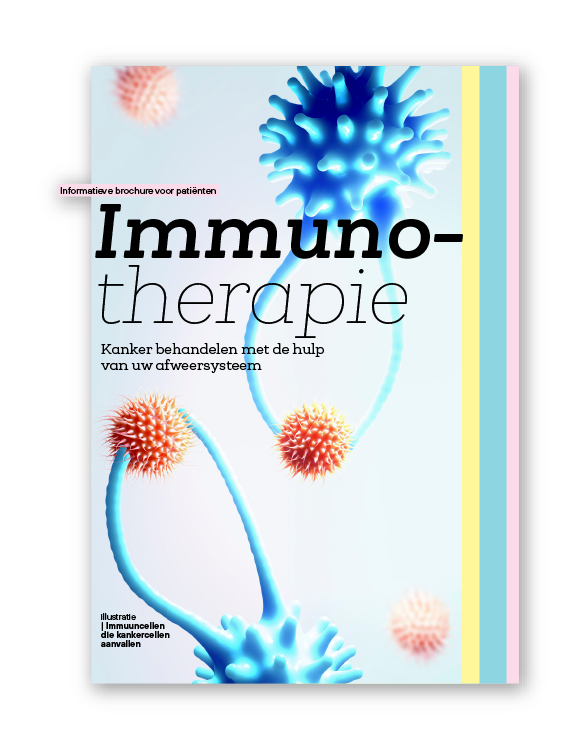
For patients in Belgium and Luxembourg, an immunotherapy brochure is available. You can download it here. For patients in Belgium and
For patients in the Netherlands, please contact your physician for more information.
Each of these methods aims to boost the organism’s immune response to cancer, allowing it to be controlled better or even cured.
Checkpoint inhibitors are medicines that can reactivate the immune system in areas where it has been suppressed by the tumour.
Cancer cells can send inhibitory signals to specific immune cells, such as T cells, to prevent their activation. By suppressing T cells, cancer cells avoid being attacked by the immune system. Checkpoint inhibitors can switch off this inhibitory mechanism, allowing the immune system to attack the cancer cells again.
For more information download the immunotherapy brochure (for patients in Belgium and Luxembourg).
Antibodies are proteins that can attach to specific targets, also called antigens, on abnormal cells such as cancer cells. Through this binding, immune cells are able to recognize and attack the cancer cells.
In treatment with bispecific antibodies, a single antibody can bind simultaneously to two different antigens. One part usually binds to a target on the cancer cell, while the other part binds to an immune cell. This creates close contact between the two, activates the immune cell, and enables it to specifically attack and eliminate the cancer cell.
An example of this mechanism are BiTEs, in which binding occurs to T cells.
Trispecific antibodies can bind to an additional antigen, for example on a T cell or on additional cancer cells. This provides extra activation and can further enhance the destruction of cancer cells.
For more information download the immunotherapy brochure (for patients in Belgium and Luxembourg).
Synthetic antibodies binding to a specific target or antigen.
Monoclonal antibodies are synthetic antibodies (laboratory-engineered antibodies) that attach to one specific target or antigen. Through this targeted binding to the cancer cell, a signal is given that the cell is abnormal. This allows immune cells to recognize and destroy the cancer cell.
Antibodies linked to a toxic substance or to radiation.
Another way of destroying cancer cells using monoclonal antibodies involves linking the antibody to a toxic substance such as a chemotherapy agent, a cytokine or a form of radiation, thereby ensuring that it is administered in a targeted way to the cancer cell.
For more information download the immunotherapy brochure (for patients in Belgium and Luxembourg).
Administering stem cells from a donor (allogeneic) which transform into a new immune system.
Before the transplant, the patient’s bone marrow and immune system are largely destroyed using a combination of chemotherapy and/or radiotherapy and/or
antibodies. This intensive conditioning treatment has three objectives: it destroys as many remaining cancer cells as possible, it creates space in the bone marrow
so that the donor stem cells can properly engraft, and it suppresses the immune system to prevent rejection of the donor stem cells.
To further reduce the risk of rejection, a good match in tissue type (HLA) is important. Therefore, a suitable donor is first sought within the family, usually a brother
or sister. If no suitable donor is found, a donor can be searched for in an international donor registry. When this is not successful or takes too long, a haplo-identical
family donor or umbilical cord blood may also be considered.
After the transplant, the donor stem cells develop into a new immune system. This new immune system can recognize and attack cancer cells, which for some aggressive diseases may offer the only chance of cure. However, it remains a very intensive treatment with an increased risk of serious complications and even death.
For more information download the immunotherapy brochure (for patients in Belgium and Luxembourg).
At an autologous stem cell transplant, the patient receives their own stem cells back after chemotherapy.
In the case of an autologous stem cell transplant, stem cells are first collected from the patient. The patient’s immune system and bone marrow are then largely
destroyed using a combination of chemotherapy and/or radiotherapy. Afterwards, the stem cells that were previously collected are infused again. The healthy
stem cells recover and regenerate the patient’s bone marrow and immune system.
In contrast to an allogeneic transplant, there is no risk of immune rejection because the cells originate from the patient’s own body. Autologous stem cell
transplantation is often used to treat certain types of cancer, particularly lymphomas and multiple myeloma. Although this treatment is intensive and carries a risk
of complications, especially infections due to temporary suppression of the immune system, it is generally less risky than an allogeneic stem cell transplant, as
complications such as rejection and graft-versus-host disease are avoided.
For certain aggressive diseases, an autologous stem cell transplant may offer a chance of remission or cure. However, a prolonged hospital stay and close monitoring are required to manage side effects and minimize the potential risks of the treatment.
For more information download the immunotherapy brochure (for patients in Belgium and Luxembourg).
At the start of immunotherapy, some patients may experience fever, nausea, or headache. Allergic reactions are rare but can potentially be serious. These must be monitored closely. Your doctor can guide you and provide medication if needed to relieve side effects.
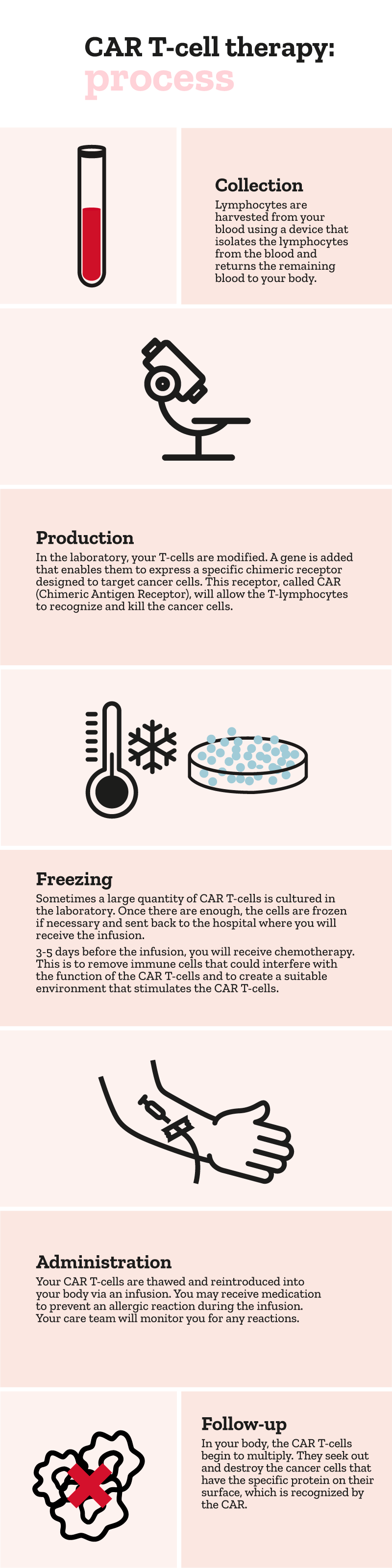
How CAR T works
A CAR T-cell treatment begins with collecting T-cells from the patient. These cells are then modified in a laboratory so that a chimeric antigen receptor (CAR) appears on the outside of the cell. This CAR enables the T-cells to recognize and destroy cancer cells.
At present, CAR T-cell therapy is given to patients whose initial treatment has not had sufficient effect, or whose disease has returned after that treatment.
For more information, please visit our page dedicated to CAR T-cell therapy.
To find out more, please visit our dedicated pages. Together, we can help you understand and manage this disease better.


NL-UNB-1824 | Date of preparation: January 2026