
You have been sucessfully logged out.

Understanding the patient’s journey with CAR T-cell therapy is crucial for anyone who is considering that option. Here are the main steps in the process.
CAR T-cell therapy is a form of cell therapy that uses your own lymphocytes (T cells) to fight your cancer.
Your T-lymphocytes are collected using a procedure called leukapheresis.
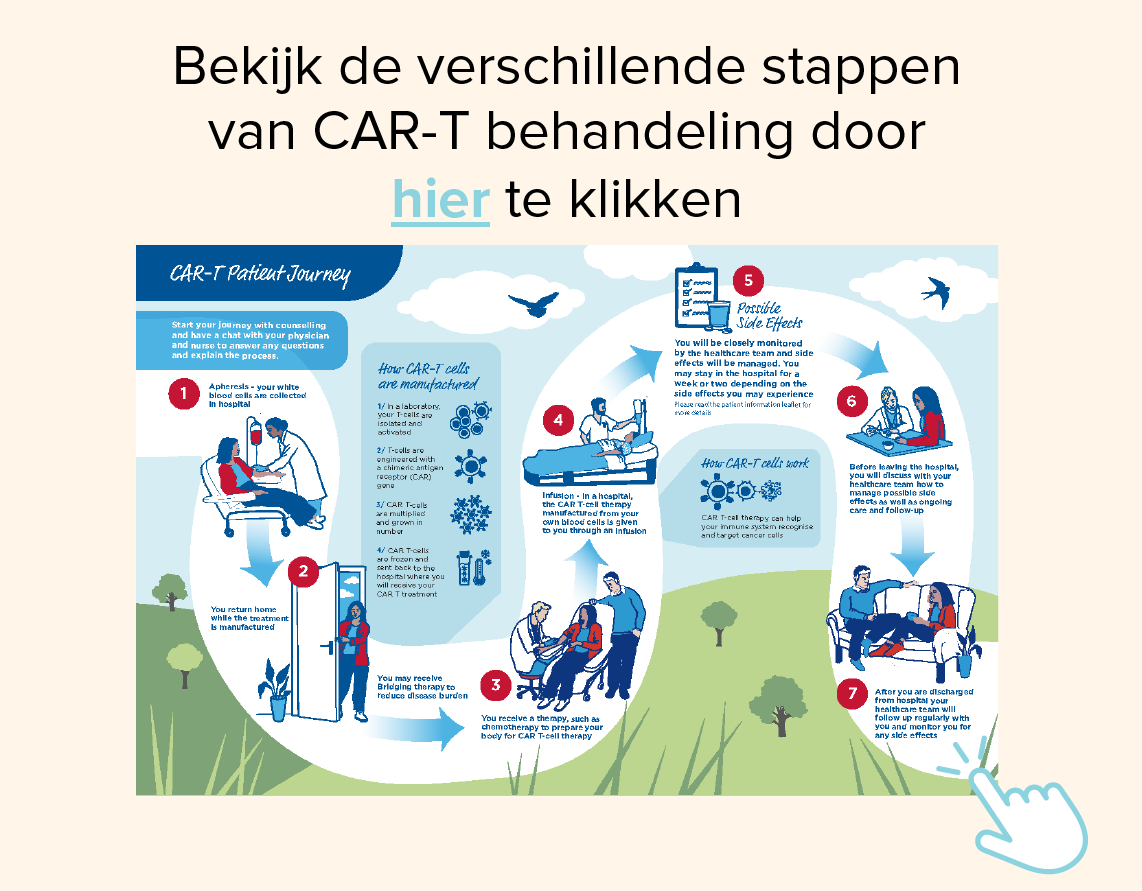
The T cells are sent to a laboratory where they are modified genetically to express a chimeric antigen receptor (CAR).
A form of chemotherapy is given to prepare the patient’s body before the CAR T-cells are reinjected.
The modified cells are reintroduced into your body by intravenous infusion.
Your care team will monitor you for possible side effects and advise you about how to manage these potential side effects as well as possible.
How it works

A new genetic code is inserted to the genetic material of the T cells. As a consequence, a specific receptor (a chimeric antigen receptor, CAR) appears on the surface of the T cells. Your CAR T cells will then be re-administered by infusion. Thanks to this CAR receptor, the T cells will be capable of detecting and tackling the cancer cells. The result is that the T cells become active, killing the cancer cells and moreover activating the immune system.
The entire production process, from when the T cells are harvested through to when the CAR T-cells are re-administered intravenously, can take several weeks before the infusion of CAR T-cells, you will be given a form of chemotherapy (known as lymphatic depletion chemotherapy).
Your care team will provide follow-up in the form of regular check-ups.
CAR T-cell therapies are currently used principally for blood cancers and lymphomas. Numerous clinical trials are ongoing for determining whether CAR T-cell therapy is equally effective against solid tumours.
Like all anti-cancer treatments, CAR T-cell therapy can produce side effects. Most of the side effects can be controlled by taking medication temporarily.
Some symptoms may seem mild but can worsen quickly. If left untreated, they can cause serious complications. It is essential that you inform your doctor WITHOUT DELAY if you experience any of the side effects below or if you get the impression that the symptoms are worsening.
It is important to know what the di erence is between a referral centre and a treatment centre for CAR T-cell therapy. There are several centres in Belgium, Luxembourg and the Netherlands specialising in this type of treatment.
Referral centres
Treatment centres
Here is a list of the treatment centres for CAR T
You will be reassured to know that the referral centres and treatment centres work closely together. Even if you are treated at a different centre from the one where you usually receive care, your usual medical team will keep monitoring you remotely.
In Belgium
In Luxembourg
In the Netherlands
Your doctor can provide personalised information and determine whether this is the appropriate treatment for your situation. For further information, please take look at our web pages dedicated to lymphoma and its treatments. Talk about it with your haematologist.
To find out more, please visit our dedicated pages. Together, we can help you understand and manage this disease better.

NL-UNB-1824 | Date of preparation: January 2026